16.06.2026
Putting the human face first in the era of AI driven marketing.
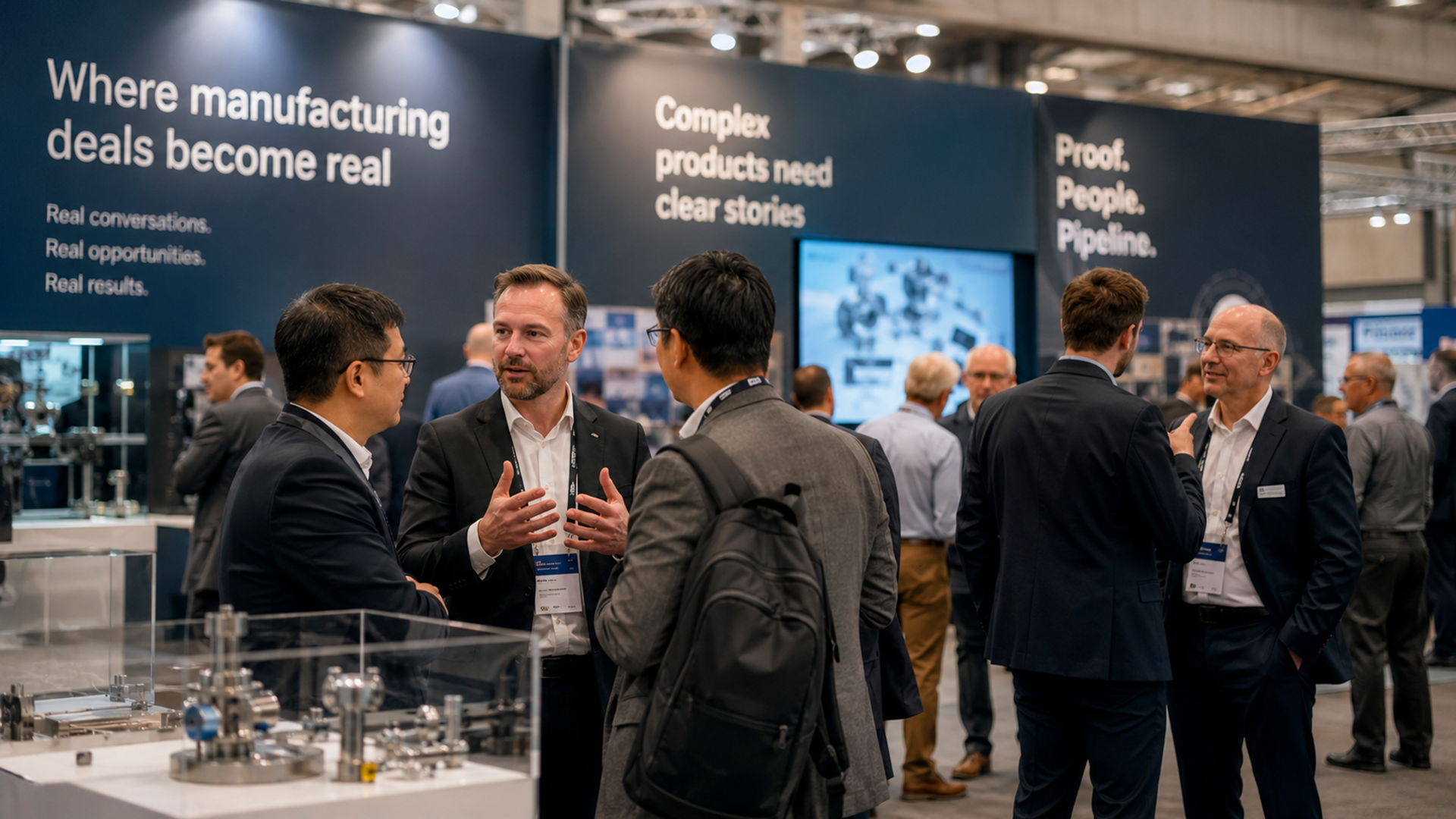
Where manufacturing deals become real
Manufacturing has always had a practical relationship with marketing. A campaign may create awareness, a website may explain capability and a technical article may help build credibility, but for many engineering businesses, the most valuable conversations still happen when people are standing in front of a product, a system, a demonstration or a specialist who can explain what it all means.
That matters more than ever.
Manufacturing products are becoming harder to explain in simple terms. Automation platforms, control systems, software, motion technology, energy infrastructure, digital manufacturing tools and industrial networks often deliver their value through performance, integration, uptime, data, safety, resilience or efficiency. These are not always easy things to communicate through a conventional advert or a short piece of online content.
At the same time, buyers are surrounded by more content than ever. Digital advertising continues to grow, with digital expected to represent nearly 69% of global ad investment in 20261. AI has made content faster and easier to produce, but it has also made much of it easier to ignore. Buyers can research independently, compare suppliers online and move through large parts of the buying journey before speaking to a sales team.
That does not make human interaction less important. It makes the right human interaction more important.
In manufacturing, confidence is not built by visibility alone. It is built through proof. Buyers need to understand how a solution works, how it fits their environment, what problem it solves and who will support it when the pressure is on. That is why exhibitions, trade shows and live events continue to play such an important role in industrial marketing.
Attendance is commercially vital
The exhibition sector has had to work through a difficult few years, but the audience is still there. CEIR reported that the US B2B exhibition industry reached an index level of 93.6 in 2025, still below 2019 levels, but with attendance showing growth of 4.7%2. That distinction is important. Exhibitor budgets, build costs and revenues may still be under pressure, but visitor appetite remains a strong signal.
Major manufacturing events continue to show the same pattern. SPS 2025 attracted 55,938 visitors, up 9% on the previous year, with 1,175 exhibitors across 122,000 square metres of presentation space3. Hannover Messe 2025 brought together more than 123,000 visitors from 150 countries and 4,000 exhibiting companies, with AI, automation and energy efficiency among the central themes4. MACH positions itself as a meeting point for UK manufacturing engineers, buyers, specifiers and suppliers, attracting 26,000 attendees and more than 600 exhibitors5.
These numbers matter because they show that events are not just surviving as legacy marketing activities. They remain places where manufacturing audiences actively choose to spend time, compare suppliers, see technology and have conversations they cannot easily have elsewhere.
For a manufacturer, that density of attention is hard to replicate
A trade show brings together engineers, directors, procurement teams, distributors, technical specialists and commercial decision-makers in one environment. People arrive with problems to solve, suppliers to assess and projects to progress. The opportunity is not just footfall. It is the concentration of relevant people with relevant questions.
AUMA’s research into trade fair visits makes that point clearly. Its study of nearly 3,000 trade fair participants found that visitors made an average of 13.1 business contacts per day, while avoiding 5.1 separate business trips6. In other words, events compress activity. They bring together conversations that might otherwise take weeks or months of separate travel, emails, calls and meetings.
For manufacturing businesses, that compression has real value. It gives sales and technical teams the chance to qualify interest quickly, understand buying needs, answer objections and move relationships forward while the customer is actively engaged.
Events help turn interest into pipeline
The commercial role of events is not limited to awareness. They can influence pipeline, conversion and deal velocity.
Splash and Cvent’s 2025 Outlook on Events found that 52% of marketers attributed at least half of their company’s 2024 closed-won deals to events. It also found that 72% said prospects close deals faster after attending events, while 31% reported a 20 to 30 day decrease in sales cycle length due to events 7.
Those figures are not manufacturing-specific, but they are highly relevant to manufacturing because industrial buying journeys are often long, technical and multi-stakeholder. A buyer may have seen the brand before. They may have visited the website, read an article or received sales communication. But the event is often where the opportunity becomes more tangible.
A good event conversation can reveal whether the problem is urgent, who is involved in the decision, what technical barriers exist and what proof the buyer needs next. It can uncover a project that was not visible in digital analytics. It can help a sales team understand whether a contact is browsing, benchmarking, specifying or actively preparing to invest.
This is where face-to-face marketing earns its place. It does not replace digital marketing. It gives digital marketing somewhere to land.
A buyer may discover a company online, see a product announcement on LinkedIn, receive an email invitation or read a technical article before the show. But once they are on the stand, the relationship changes. The product can be demonstrated. The technical detail can be explained. The value can be connected to the buyer’s own environment. The conversation becomes specific.
Complex products need clear stories
The more abstract the product, the more important the story becomes.
Many manufacturing businesses struggle because their most valuable capabilities are not always visually obvious. A drive, controller, network, software platform, hydraulic system, safety solution or service model may look relatively simple from the outside, but the value sits in what it enables. Less downtime. Faster integration. More reliable data. Lower maintenance. Greater energy efficiency. Better visibility. Stronger resilience. Reduced risk.
That is where exhibition design, AV and content have a strategic role. They are not decoration. They are translation tools.
A strong stand environment can make the invisible visible. A product animation can show what happens inside a system. A touchscreen can guide different visitors towards relevant information. A film can connect technical features to operational outcomes. A live demonstration can create trust in a way that a brochure cannot. A well-structured graphic hierarchy can help a visitor understand the proposition within seconds.
This is especially important in the era of AI-driven marketing. As more businesses use AI to create content, the risk is that messaging becomes broader, flatter and more interchangeable. Manufacturing brands cannot rely on generic claims about innovation, efficiency or performance. They need specific stories that show why their technology matters and why their people can be trusted.
Events are powerful because they allow those stories to be experienced. They put people, products and proof in the same place.
Message platforms need to understand the buyer
A manufacturing buying decision is rarely made by one person. The engineer, the operations lead, the procurement team, the project manager and the senior decision-maker may all influence the outcome, but each of them will be looking for different forms of confidence.
The engineer may want technical credibility. The operations lead may want reassurance around uptime, integration and support. Procurement may want supplier stability, value and risk reduction. Senior leadership may want to understand commercial impact, resilience, productivity or long-term strategic benefit.
That means a message platform cannot simply say the same thing louder. It has to say the right thing clearly to the right people, while keeping everyone inside the same story.
At an exhibition, this matters immediately. Visitors make fast judgements. They need to understand who the exhibitor is, what problem they solve and whether the stand is worth their time. A strong headline should carry the main proposition. Supporting messages should help different personas recognise their own needs. Deeper content should then give sales and technical teams the detail they need to progress the conversation.
Clarity is of the utmost importance because confusion slows everything down. If the message is too broad, it becomes forgettable. Too technical, it risks excluding commercial stakeholders. If it is too high-level, it fails to satisfy the engineers who need proof. The best message platforms create layers of understanding, from immediate impact to deeper technical and commercial relevance.
This also helps the exhibitor. When the messaging has been properly developed, the team has a shared structure for conversations. They are not reinventing the story with every visitor. They can qualify more effectively, guide people to the right content and make sure the stand supports the buying journey rather than relying entirely on individual sales conversations.
Attendance creates the opportunity, execution determines the return
A busy event creates potential. A well-planned exhibition programme turns that potential into value.
For exhibitors, shows can be demanding. There are deadlines, logistics, build requirements, graphics, product demos, AV, staffing, content, travel, hospitality, meetings, lead capture and follow-up to manage. The pressure is even greater when the event is international, the products are technical and the stand has to represent the business at a high level.
This is where a well-run, well-designed, well-built and well-managed exhibition programme can take the strain away from the exhibitor. When the stand is planned properly, the team can arrive with confidence. They know the build quality has been managed, the message platform has been thought through., the visitor journey makes sense, the AV works, the content is ready, the demonstrations are supported and the lead capture process is in place.
That peace of mind matters because the exhibitor’s real job is not to worry about the stand. It is to meet customers, build relationships and progress opportunities.
A good exhibition strategy starts before the doors open
Attendance awareness should be built in advance through email, social media, website news, personal sales outreach and appointment setting. The message should not simply be “we are exhibiting”. It should give people a reason to visit. Come and see this technology, talk to us about this challenge, meet the team and understand how this solution applies to your operation.
During the show, the stand should become a live content platform. Daily posts, short videos, product walk-throughs, pieces to camera, team introductions and demonstration clips can all help extend the reach of the event beyond the hall. “We’re here, we’re ready” is a simple but effective message when it is backed by useful content and clear calls to action.
This activity also gives sales teams more reasons to engage. A customer who cannot attend can still see what is being shown. A prospect who is walking the halls can be reminded to visit. A distributor can share content with their network. A product specialist can explain a technical point on camera. The event becomes more than a three-day presence. It becomes a concentrated campaign.
After the show, the follow-up should already be planned. Leads need to be segmented, not simply collected. A technical enquiry should not receive the same response as a senior stakeholder who requested a meeting. A warm opportunity should not wait weeks for contact. Photography, video, stand content and show insights can be repurposed into recap posts, emails, case study prompts and sales material.
The most effective exhibition programmes use every channel before, during and after the event. They do not treat the stand as an isolated build. They treat it as the centre of a wider marketing and sales system.
The human face of manufacturing marketing
AI will continue to shape how buyers research, compare and shortlist suppliers. Digital content will remain essential. Advertising will still have a role. But in manufacturing, the moment of confidence often still depends on people.
Gartner found that 67% of B2B buyers prefer a rep-free experience, with 45% using generative AI during a recent purchase. Yet separate Gartner research found that 69% of B2B buyers prefer to validate AI-generated insights with sales representatives8. That combination says a lot about the modern buying journey. Buyers want control, but they also want confidence.
For manufacturing brands, exhibitions provide that confidence when they are done well. They allow complex products to be demonstrated, technical questions to be answered and different buying personas to find the information they need. They give sales and engineering teams the chance to put a human face to specialist expertise.
That is why events remain so important. Not because they are traditional, but because they are specific. They create moments where interest becomes understanding, understanding becomes trust and trust becomes a serious commercial conversation.
For manufacturing marketers, the opportunity is not simply to attend more events. It is to make every event work harder. With the right strategy, message platform, stand design, AV, content, lead capture and follow-up, an exhibition can become one of the most valuable points in the entire buying journey.
In a world where content is easier to create than ever, the strongest manufacturing stories may still be the ones people can stand in front of.
For an example of how this thinking comes together in practice, see how Oyster helped Langley Holdings create a flagship exhibition presence at POWERGEN 2026, combining stand design, messaging, AV and project delivery to support a high-value international event.
1 Dentsu forecasts digital advertising to represent 68.7% of total global ad investment in 2026.
2 IAEE’s CEIR commentary reports that the 2025 CEIR Index reached 93.6, with attendance growing 4.7%.
3 SPS 2025 reported 55,938 visitors, 1,175 exhibitors and 122,000 square metres of presentation space.
4 Hannover Messe 2025 reported more than 123,000 visitors from 150 countries and 4,000 exhibiting companies.
5 MACH states that it attracts 26,000 attendees and more than 600 exhibitors.
6 AUMA’s study found that trade fair visitors made an average of 13.1 business contacts per day and avoided 5.1 individual trips.
7 Splash/Cvent reported that 52% of marketers attributed at least half of their 2024 closed-won deals to events, 72% said prospects close faster after attending events and 31% reported a 20 to 30 day decrease in sales cycle length.
8 Gartner reported that 67% of B2B buyers prefer a rep-free experience, 45% used generative AI during a recent purchase and 69% prefer to validate AI-generated insights with sales reps.